Beyond the Stroke Prognosis: Grip Strength, Brain Plasticity and the Hope Center Story
Dr. Joseph Schneider and Dr. Jerome Rerucha explores grip strength as one of the most powerful, yet neglected predictive health markers in modern medicine. In this episode of My POTS Podcast, they describe how nearly 50,000 research papers on PubMed link grip strength to cardiovascular disease, stroke, Parkinson’s disease, osteoporosis and overall longevity. Despite this evidence, most medical practice still overlooks grip strength testing in favor of complex procedures that often provide less predictive value.
About This Blog
Dr. Joseph Schneider and Dr. Jerome Rerucha explores grip strength as one of the most powerful, yet neglected predictive health markers in modern medicine. In this episode of My POTS Podcast, they describe how nearly 50,000 research papers on PubMed link grip strength to cardiovascular disease, stroke, Parkinson’s disease, osteoporosis and overall longevity. Despite this evidence, most medical practice still overlooks grip strength testing in favor of complex procedures that often provide less predictive value.
At the center of the discussion is Dr. Schneider’s own story. A devastating stroke, a bleak hospital prognosis, and a clear inner call to build what became the Hope Brain Body Recovery Center set the stage for a new model of care. His clinic now combines advanced technology, detailed assessment, and a faith-driven mission to help people who have been told that nothing more can be done.
Grip Strength Research Few Doctors Use
Jerome explains how easy it is to verify the science. A simple search for “grip strength” on PubMed produces nearly 50,000 peer-reviewed papers. Within that, there are thousands of studies on specific relationships:
Grip strength and cardiovascular disease
Grip strength and stroke outcomes
Grip strength and Parkinson’s progression
Grip strength and osteoporosis and bone density
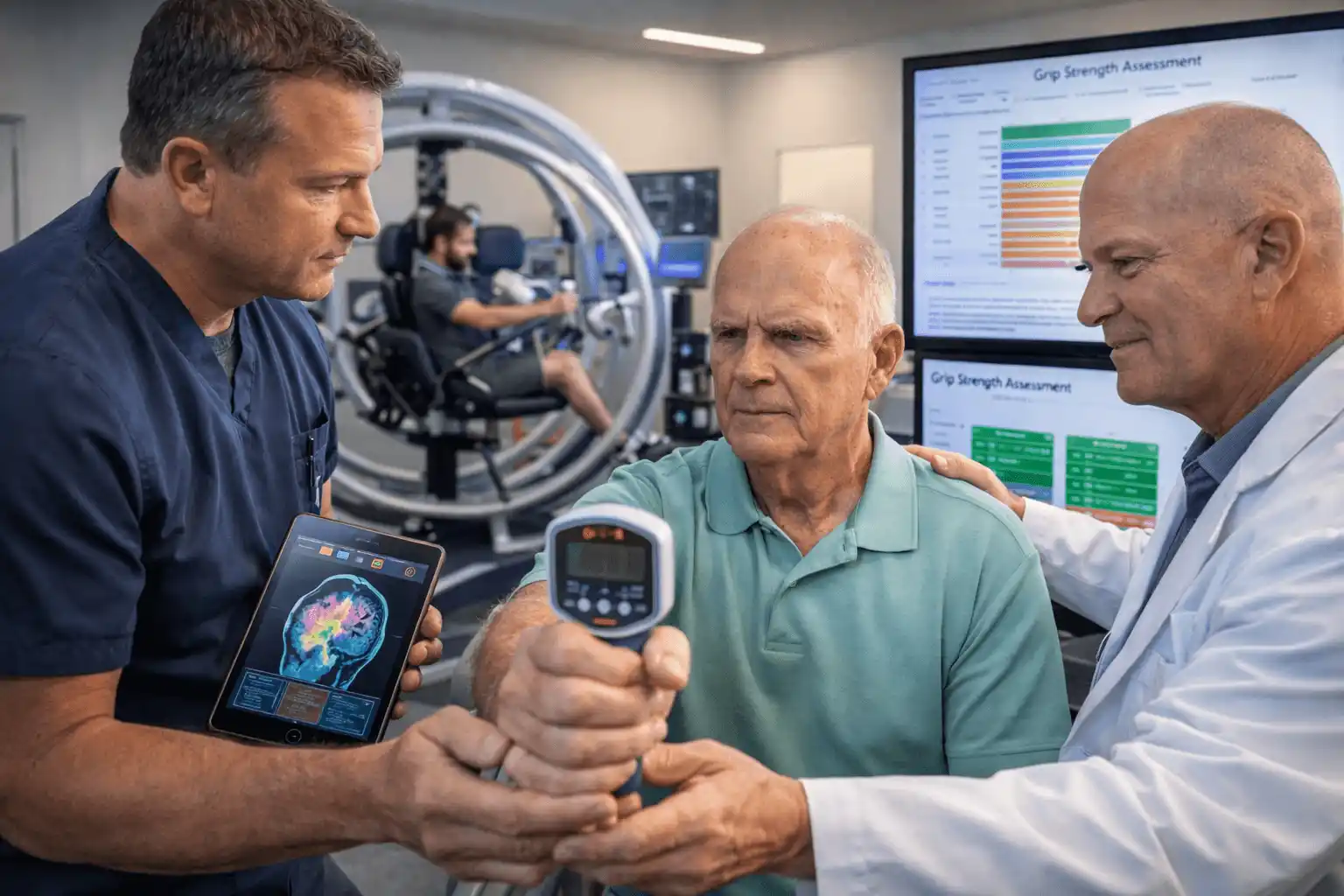
The testing itself is straightforward. A handheld dynamometer is inexpensive, quick to use and provides clear numbers. It does not require a large facility, complicated equipment, or a long appointment. Because it is so simple, researchers have been able to follow huge populations for long periods. One set of studies followed about 500,000 people for 32 years and tracked grip strength against major health outcomes. Those data sets are powerful and paint a clear picture. As grip strength declines, risk across many disease categories rises.
Jerome raises a hard question. If the research is so strong and the tool is so simple, why are most clinics not using it in any meaningful way? In his experience, many physicians rely heavily on what drug representatives present during routine visits. Insurance billing rules and standard protocols often drive choices more than independent review of the literature. In that environment, a low-cost test that does not produce large billing codes receives little attention, even if it outperforms many expensive procedures in predictive value.
A Stroke, a Prognosis and a New Direction
In 2017, Dr. Schneider suffered a hemorrhagic stroke that nearly ended his life. Hospital staff delivered the familiar script: get your affairs in order, apply for disability, prepare for a passive and highly limited existence. There was no clear plan for meaningful rehabilitation and no expectation of real recovery.
During his near-death experience, Dr. Schneider sensed a very specific instruction: Hope Center. The message arrived at a time that made no sense on paper. He had already lost two businesses. Debt was growing. He needed help with basic daily activities. His wife had every reason to question any talk of opening a new clinic.
In that crisis, his spiritual life moved to the center. The question shifted away from personal loss and toward purpose. Instead of asking why the stroke happened, he began to ask what he was meant to do through it. His earlier work in engineering, where he designed control systems for power plants, helped him see the brain in similar terms. The brain acts as the master control unit for the entire body. It responds to patterns of input. It can adapt and reorganize. It does not only respond to medication.
Over time, this insight, together with that inner call, became the foundation for the Hope Brain Body Recovery Center. The clinic focuses on people whose lives have been dismantled by stroke, traumatic brain injury, functional neurological disorders, POTS and other complex conditions. Many of them have already been told there is no real hope for improvement.
Building the Hope Brain Body Recovery Center
Today, the Hope Brain Body Recovery Center operates with about two million dollars invested in diagnostic and therapeutic technology. Dr. Schneider and his team use:
Neurofeedback systems
Gyrostim rotational and vestibular training
Whole-body vibration platforms
Advanced balance and gait assessment tools
Stem cell and exosome protocols under medical supervision
Comprehensive metabolic and nutritional programs
These tools are not simply gadgets. They are part of structured programs that measure function, apply carefully chosen stimuli, and then verify change. The clinic routinely sees cases that conventional care has labeled as “no further options.”
Examples include:
- A young woman diagnosed with a functional neurological condition who was passing out several times a day. With intensive care, her episodes decreased from six events a day to about two.
- Stroke survivors who had been told to accept permanent disability who now regain significant function.
- Patients with functional neurological disorders who reach 60 to 70 percent improvement after years of stalled progress under standard care.
These outcomes did not just convince patients. They changed the mind of the person who once resisted the investment most strongly: Dr. Schneider’s wife.
The Story Behind the Technology Investment
In the early stages of his recovery, every new piece of equipment looked like another financial risk. Income had fallen. Medical and living expenses had climbed. Under those conditions, Dr. Schneider’s wife asked him to promise that he would not purchase more systems. Her concern was reasonable.
As the clinic began to see consistent improvements in difficult cases, her perspective started to change. She watched people whose lives had been shrinking regain abilities and hope. At that point, new devices no longer looked like pure expense. They looked like tools that made crucial differences in real lives.
Eventually, she took over responsibility for equipment decisions herself. One of the most recent systems cost around three hundred and twenty thousand dollars. Dr. Schneider assumed she would refuse such a large purchase. Instead, she weighed the results they were already seeing and decided the cost was justified.
The pattern is simple. When methods work and outcomes are measurable, investment in better assessment and treatment tools becomes rational rather than reckless. This stands in sharp contrast to common medical practice, where equipment choices are often shaped by what insurance will easily reimburse, not by what best serves complex patients.
Shared Rules for Athletes and Fragile Patients
Jerome explains that high-level athletes and tenuous patients live at different performance levels, yet the rules that guide their progress are the same. Both require:
Clear baseline measurements
Structured progression in activity
Training of endurance so gains remain stable over time
He learned these principles in the world of competitive strength sports. Making an already strong, healthy person even more capable demands very precise changes in load, volume, and technique. In a clinical setting, the same thinking applies when working with someone who struggles to stand, walk, or focus.
Body composition testing offers a simple example. A 25-year-old who appears normal in street clothes may test at 44 percent body fat. That level of low muscle and high fat often reflects a weak nervous system, poor metabolic health, and early bone loss. Further testing frequently confirms osteopenia or osteoporosis. Standard medicine tends to wait until much later to look for such problems.
Grip strength adds another layer. When a person performs grip testing on a vibration platform, the nervous system receives a large amount of sensory and mechanical input in a very short period. For someone who cannot tolerate long workouts, this approach delivers a strong training effect without exhausting them.
In Jerome’s view, the same three pillars apply in both the gym and the clinic: precision, stamina, and endurance. The numbers change. The principles do not.
When Money Shapes Medicine More Than Evidence
A central theme in their conversation is the gap between what research shows and what patients receive in most clinics. Grip strength testing checks every practical box. It is:
Inexpensive
Quick
Non-invasive
Easy to repeat
Strongly supported in the literature
Yet it generates very little revenue. It does not require a specialist referral, high imaging fees, or a complex procedure. It simply provides information that can guide training, rehabilitation, and lifestyle change.
The current medical business model rewards something else. Complex imaging, laboratory panels, and procedures create billing codes. Abnormal findings often lead to long-term prescriptions. Specialist visits multiply encounters within the same insurance network. In that environment, a simple device that costs less than a typical visit and can outperform many reimbursed tests in predictive power has no obvious financial champion.
This tension helps explain why many people with chronic or complex problems end up in offices like Dr. Schneider’s. Functional, neurological, and integrative practices can step outside rigid billing rules. They can apply research that highlights simple tools, lifestyle change, and precise neuromuscular training, even when those steps are not well paid by insurance.
Taking the First Step Toward Better Prevention
Grip strength is often treated as a small detail. The research suggests it is a central signal. It reflects nervous system output, muscle mass, metabolic health, and resilience in a way that is easy to measure and track. When such a large body of evidence points in the same direction, it deserves serious attention.
Dr. Schneider and Jerome argue that paying attention to this type of simple, powerful marker can help people act long before crisis hits. It supports better decisions about movement, nutrition, neurological training, and overall strategy for long-term health.
To learn more about grip strength testing, body composition analysis, advanced neurological rehabilitation and the technology used at the Hope Brain Body Recovery Center, listen to the full episode of My POTS Podcast and visit HopeBrainCenter.com or call 610-544-9800. A basic grip test can reveal more about your future health than many costly procedures and offers a practical starting point for real prevention.
Connect with Dr. Joseph Schneider:
Website: Hope Brain and Body Recovery Center; Hope Regeneration Center
Podcast: MyPOTSPodcast.com
LinkedIn: Joseph Schneider
YouTube: HopeBrainBodyRecoveryCenter
Instagram: @HopeBrainCenter_
Facebook: Hope Brain and Body Recovery Center
Connect with Jerome Rerucha:
LinkedIn: @JeromeRerucha
Website: www.performancepractic.com/
Related Blog
Duis mi velit, auctor vitae leo a, luctus congue dolor. Nullam at velit quis tortor malesuada ultrices vitae vitae lacus. Curabitur tortor purus, tempor in dignissim eget, convallis in lorem.


Comments